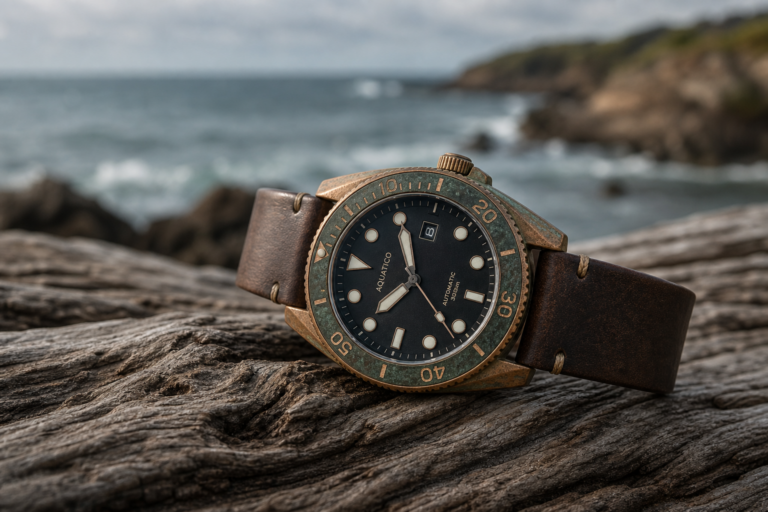
Why Bronze? The Complete Guide to Bronze Watches
Bronze watches have exploded in popularity over the past decade, but what makes this ancient alloy so special for watchmaking? In this guide, we break down everything you need to know.
A Brief History
Bronze has been used by humans for over 5,000 years. From ancient weapons to ship fittings, its durability and corrosion resistance made it the material of choice for anything that needed to survive harsh conditions. In watchmaking, bronze first appeared in vintage diving instruments — and that heritage lives on in modern bronze dive watches.
What is CuSn8 Bronze?
Not all bronze is created equal. CuSn8 (92% copper, 8% tin) is the marine-grade alloy preferred by serious watchmakers. It offers:
- Superior corrosion resistance in saltwater
- Warm, golden tone that deepens over time
- Hypoallergenic properties (no nickel)
- Excellent machinability for precise case finishing
The Magic of Patina
The defining characteristic of a bronze watch is its patina — the natural oxidation that develops on the surface over time. This is not corrosion or damage. It is a protective layer that:
- Makes every watch completely unique
- Tells the story of how you live and wear your watch
- Can be removed and restarted at any time
- Actually protects the underlying metal
Bronze vs. Stainless Steel
| Feature | Bronze | Stainless Steel |
|---|---|---|
| Uniqueness | Every watch ages differently | Stays the same |
| Weight | Slightly heavier | Standard |
| Warmth | Warm golden tone | Cool silver tone |
| Maintenance | Optional patina management | Minimal |
| Heritage | Maritime/military history | Modern industrial |
Is a Bronze Watch Right for You?
A bronze watch is perfect if you:
- Appreciate things that age gracefully
- Want a watch that is truly one-of-a-kind
- Love the warm, vintage aesthetic
- Enjoy the idea of your watch telling your story
It might not be for you if you prefer a watch that looks exactly the same on day 1,000 as it did on day 1.